
What to Expect From a Refrigerator Repair Visit
A refrigerator that stops cooling puts a week of groceries at risk, so you want it fixed quickly and correctly. The visit goes better when you know what the technician will look for and what information helps most.
Here is how a refrigerator repair visit usually works, from the first call to the finished repair. We'll cover what to tell us, what gets tested first, the repairs behind common symptoms, when the sealed system is involved and how to decide between repairing and replacing.
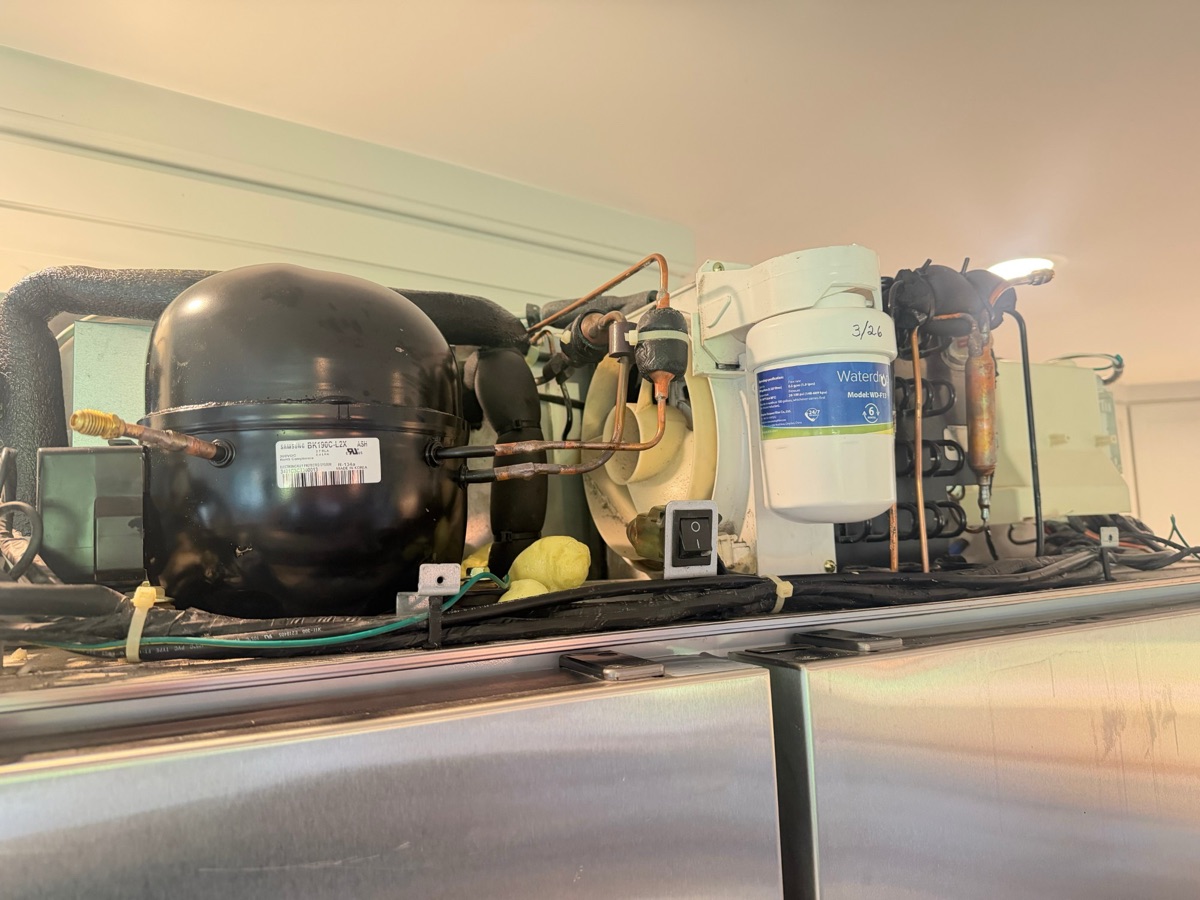
What to Tell the Technician Before the Visit
Good information shortens the diagnosis. When you call or send a request, have these ready:
- The symptom, in your own words. Warm, leaking, noisy, not making ice, a blank display.
- Which compartment has the problem. A warm refrigerator with a cold freezer points to different parts than a refrigerator and freezer that are both warm.
- When it started and what changed. A power outage, a new noise, frost building up.
- Any error code or flashing display. Write it down exactly as it appears.
- The model number. It is on a label inside the refrigerator. A photo of that label sent with your request helps us plan the visit.
While you wait, keep the doors closed as much as you can. Refrigerators should hold food at or below 40°F and freezers at 0°F, and a thermometer in each compartment shows what is really happening. See the federal cold food storage chart for the guidelines.
What a Refrigerator Technician Checks First
A refrigerator makes cold in one place and moves it to another, so the diagnosis follows the cold. A good refrigerator technician starts with the simple causes and works toward the involved ones:
- Power and the outlet, plus the temperature settings.
- The condenser coil and condenser fan. The coil releases the heat the refrigerator removes. Dust or a failed fan makes the compressor run longer and hotter.
- The evaporator fan, which moves cold air from the freezer into the refrigerator.
- The defrost system (heater, sensor and control). When it fails, frost builds up until air can't flow.
- The thermistor, a temperature sensor that tells the control board when to run the compressor and fans.
- The control board and its wiring.
- The door seals.
- Only then, the compressor and sealed system.
Skipping straight to the compressor is how the wrong part gets replaced. Several of these causes look alike from the outside, which is why testing comes before parts. Our refrigerator not cooling guide lists safe checks you can do yourself.
Common Symptoms and What They Usually Point To
| What you notice | What it often points to | What the repair may involve |
|---|---|---|
| Refrigerator warm, freezer cold | Evaporator fan, defrost problem, stuck damper | Replacing a fan or defrost part |
| Refrigerator and freezer both warm | Condenser fan or coil, control board, compressor | Cleaning, a fan or board, or sealed-system service |
| Water on the floor or inside | Clogged defrost drain, water inlet valve, ice maker line | Clearing the drain or replacing a valve or line |
| New buzzing, grinding or clicking | A fan, a compressor mount or the ice maker | Replacing the fan or part |
| Display flashing or lights off | Control board, door switch, power | Testing, then replacing the board if confirmed |
| No ice | Frozen fill tube, water inlet valve, ice maker module | Thawing the tube or replacing the valve or module |
These are patterns, not promises. The only way to know is to test your refrigerator. For the details, see refrigerator leaking water, a refrigerator making noise and refrigerator not making ice.
When the Compressor or Sealed System Is Involved
The sealed system is the closed loop that holds the refrigerant. It includes the compressor, the condenser, the evaporator and the lines between them. A leak, a restriction or contamination inside it is the most involved repair a refrigerator can need.
A proper compressor replacement is more than swapping one part. It can include finding and repairing any leak, replacing the filter drier, cleaning out contamination, evacuating the system and charging the correct amount of refrigerant, then checking temperatures. Some refrigerators use a flammable refrigerant, so this is not a do-it-yourself job.
We confirm the cause first, because a fan, a thermistor or a control board can mimic a failing compressor. Read more on refrigerator compressor repair.
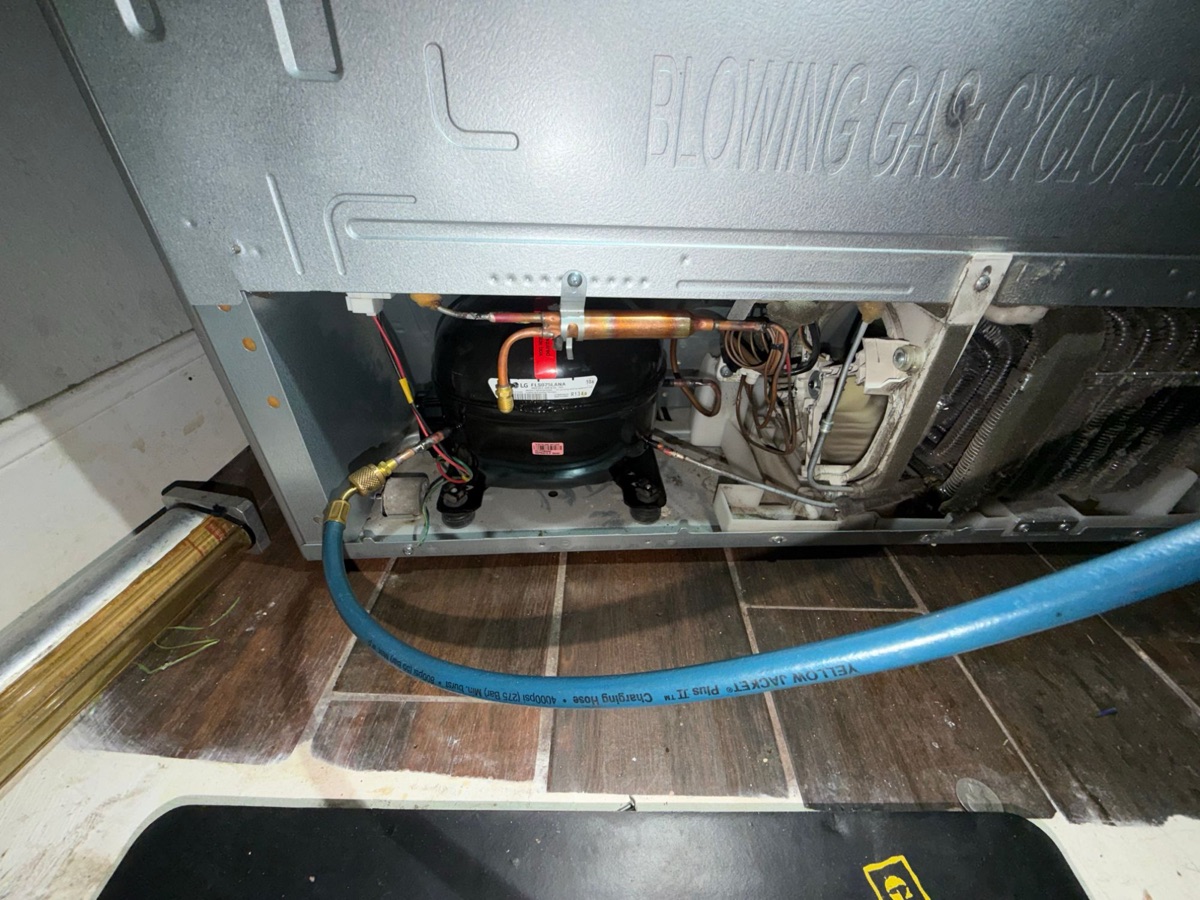
We have replaced compressors on GE and LG refrigerators that had stopped cooling. The photos are on our refrigerator repair page and on LG Refrigerator Repair in Houston. You can also watch a noisy fan before and after it was replaced.
Repair or Replace?
Ask for the price before any work begins, then weigh it against three things: the refrigerator's age and overall condition, what failed, and the price of a comparable new refrigerator.
A fan, a defrost part, a door seal or a control board on an otherwise sound refrigerator is often worth repairing. A sealed-system repair on a very old unit deserves a closer look. We give you an honest view of the cost against the refrigerator's age and condition before any work begins. Our repair-or-replace guide explains how we think about it.
How Our Refrigerator Repair Visit Works
- You call or send a request. We confirm the details and the earliest opening. Same-day appointments may be available depending on the schedule.
- The technician inspects and tests the likely causes.
- You get a clear explanation of what is wrong and the price, before any work begins.
- The repair is made and the refrigerator is tested to confirm it is working properly again.
Houstons Best Appliance Repair is owner-operated, licensed and insured, with more than 12 years of hands-on experience. Repairs we complete are backed by a 90-day repair warranty. We repair refrigerators throughout Houston and nearby areas. See refrigerator repair in Houston for the problems we repair, and Houston appliance repair for where we work.
Conclusion
Most refrigerator problems trace back to a handful of parts, and the fix starts with finding the real cause instead of guessing. Tell us what you see, send the model label if you can, and we'll test, explain and repair.
Need help with your refrigerator? Call (281) 200-7303 or schedule a refrigerator repair.
Refrigerator Repair FAQ
It depends on the cause and the part. Fan, sensor and board repairs are often shorter visits than sealed-system work. We'll tell you what to expect after the diagnosis.
Often yes, especially for a fan, defrost or door-seal repair. We'll give you an honest view of the cost against the refrigerator's age and condition before any work begins.
Clearing a path to the refrigerator helps. If the freezer or back panel has to be opened, the food in that area will need to come out, so have a cooler ready.
Yes. Built-in and column refrigerators share the same cooling-system basics as standard ones, with extra care taken around the cabinetry.
Same-day appointments may be available depending on the schedule. Call early in the day, or send a request, and we'll confirm the earliest opening.
Need This Fixed by a Professional?
If this sounds like what you're dealing with, we're glad to help.